Gla55, 10 Movements to the Music of Philip Glass
Choreography
Anne Teresa De Keersmaeker
Danced by & created with
Boštjan Antončič, Niklas Capel, Lav Crnčević, José Paulo dos Santos, Sunai Elbers, Sue Yeon Youn
Assistant & rehearsal director
Ictus & Bl!ndman
Fabian Coomans (Bl!ndman), keyboard
Chryssi Dimitriou (Ictus), flutes
Alexandre Fostier (Ictus), sound
Aisha Orazbayeva (Ictus), violin, voice
Hendrik Pellens (Bl!ndman), saxophones
Jean-Luc Plouvier (Ictus), keyboard
Piet Rebel (Bl!ndman), saxophones
Eric Sleichim (Bl!ndman), saxophones, guitar
works
Philip Glass,
MUSIC IN FIFTHS, 1969
MUSIC IN SIMILAR MOTION, 1969
MUSIC IN CONTRARY MOTION, 1969
MUSIC WITH CHANGING PARTS, 1970
Lighting Design
Minna Tiikkainen
Costumes
Aouatif Boulaich
Dramaturgy
Wannes Gyselinck
Production
Rosas
Co-Production
Berliner Festspiele, Concertgebouw Brugge (Bruges), Festival d'Automne à Paris (Parijs), Piccolo Teatro di Milano – Teatro d’Europa (Milaan/Milan), La Villette (Parijs, Paris)
With the support of
Dance Reflections by Van Cleef & Arpels
The Tax Shelter of the Belgian Federal Government, via Casa Kafka Pictures
Rosas and Ictus are supported by the Flemish Community
and the Flemish Community Commission (VGC).
Certain “early works” carry a very particular tone. They do not age, and continue to remind us of the surge of energy and radicality that accompanies the invention of a style. Today, Anne Teresa De Keersmaeker chooses, for the first time, to approach the “beginnings” of a giant of the minimalist adventure: Philip Glass. Radical and timeless, Glass’ music stands out for its paradoxical blend of hyper-formalism and a call to trance.
Music in Contrary Motion, Music in Fifths, Music in Similar Motion, Music with Changing Parts: the four pieces selected by De Keersmaeker all date from 1969–1970, a highly fertile period in the composer’s trajectory. They bear traces of a decisive encounter: during his studies in Paris a few years earlier, Philip Glass was engaged as an assistant by the Indian composer and sitar player Ravi Shankar. The latter asked him to transcribe his music into Western notation, a difficult problem that proved revelatory for Glass: “I erased all the bar lines. And suddenly, I saw the flow of the rhythm that I hadn’t seen before.”
It was at this moment that the young artist discovered the potential of music based on the combination of very brief patterns. This technique makes it possible to create a musical flow that is vertiginous and fast like a torrent—both repetitive and unpredictable. Upon his return to New York in 1967, another artistic shock awaited Philip Glass. Sobriety and reduction had become the watchwords of American modern art, championed by visual artists such as Sol LeWitt, Richard Serra, and Donald Judd.
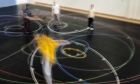
This entire aesthetic adventure nourishes the project GLA55. In it, Anne Teresa De Keersmaeker turns to a guiding principle that recurs throughout her career: to exploit to the fullest extent material reduced to its minimum. Added to this is the notion of trance, and the obsession with turning. Circles, spirals, and ellipses will play a central role in this ten-part work, along with the curve that geometers refer to as a lemniscate: the ∞ , the ribbon of infinity.
For this occasion, Anne Teresa De Keersmaeker brings together six Rosas dancers and the musicians of the ensemble BL!NDMAN—whose 2024 recording of music by Glass (ICONS, The American Minimalists) was unanimously acclaimed by critics—as well as her long-time collaborators from Ictus (for our sixteenth collaboration!). We will share our converging approaches to the music of Philip Glass, in search of a transcendental experience and a practice of dance that, like the music that carries it, “erases all the bar lines.”
Bepaalde “jeugdwerken” hebben een heel eigen klankkleur. Ze verouderen niet en blijven ons herinneren aan de energie en radicaliteit die het ontstaan van een eigen stijl kenmerken.
Vandaag besluit Anne Teresa De Keersmaeker voor het eerst de “beginselen” te benaderen van een icoon binnen het minimalistische avontuur: Philip Glass. Radicaal en tijdloos onderscheidt deze muziek zich door een paradoxale combinatie van hyperformalisme en een oproep tot trance.
Music in Contrary Motion, Music in Fifths, Music in Similar Motion, Music with Changing Parts: de vier stukken die De Keersmaeker selecteert, dateren allemaal uit de periode 1969-1970, een bijzonder vruchtbare fase in het parcours van de componist. Ze dragen de sporen van een ontmoeting: tijdens zijn studies in Parijs, enkele jaren eerder, werd Philip Glass aangeworven als assistent van de Indiase componist en sitarspeler Ravi Shankar. Deze had hem gevraagd zijn muziek om te zetten in westerse notatie, een moeilijk op te lossen probleem dat voor Glass een openbaring werd: “Ik heb alle maatstrepen weggehaald. En plots zag ik de flow van het ritme.” Op dat moment ontdekt de jonge kunstenaar het potentieel van muziek die gebaseerd is op een combinatie van zeer korte patronen. Deze techniek maakt het mogelijk een duizelingwekkende, snelle muzikale stroom te creëren, als een stortvloed: tegelijk repetitief en onvoorspelbaar.
Bij zijn terugkeer naar New York in 1967 wacht Philip Glass een nieuwe artistieke schok. Soberheid en reductie zijn de sleutelwoorden geworden van de Amerikaanse moderne kunst, uitgedragen door beeldende kunstenaars zoals Sol LeWitt, Richard Serra en Donald Judd. Dit hele esthetische avontuur is de humus van het project GLA55. Anne Teresa De Keersmaeker sluit hier opnieuw aan bij een principe dat haar hele carrière heeft gekenmerkt: minimaal abstract materiaal maximaal uitbuiten. Daarbij komen noties van trance, evenals het repetitief-obsessieve draaien rond de eigen as, ook wel ‘spinning’ genoemd. Cirkels, spiralen en ellipsen vormen de belangrijkste figuren in deze voorstelling in tien bewegingen, net als de figuur die wiskundigen de lemniscaat noemen, het ∞ teken of de lus van het oneindige.
Voor deze gelegenheid brengt Anne Teresa De Keersmaeker zes dansers van Rosas samen met de muzikanten van het ensemble BL!NDMAN, wier opnames van Glass uit 2024 (ICONS, The American Minimalists) unaniem lovend werden onthaald, en met haar vaste partners van Ictus (voor onze zestiende samenwerking!).
We delen onze verwante benaderingen van de muziek van Philip Glass, op zoek naar een transcendentale ervaring en een danspraktijk die, net als de muziek die haar draagt, “alle maatstrepen uitwist”.
Certaines « œuvres de jeunesse » dégagent une tonalité toute particulière. Elles ne vieillissent pas, et continuent de nous rappeler la poussée d’énergie et de radicalité qui accompagne l’invention d’un style. Aujourd’hui, Anne Teresa De Keersmaeker aborde pour la première fois les commencements d’un géant de l’aventure minimaliste en musique : Philip Glass. Radicale et intemporelle, cette musique se distingue par un mélange paradoxal d’hyper-formalisme et d’appel à la transe.
Music in Contrary Motion, Music in Fifths, Music in Similar Motion, Music with Changing Parts : les pièces choisies par De Keersmaeker datent toutes les quatre des années 1969-1970, période très féconde dans le parcours du compositeur. Elles portent la trace d’une rencontre : lors de ses études à Paris, quelques années plus tôt, Philip Glass avait été engagé comme assistant par le compositeur et sitariste indien Ravi Shankar. Celui-ci avait demandé de transcrire sa musique en notation occidentale, et ce problème difficile à résoudre avait agi pour Glass comme une révélation : « J’ai effacé toutes les barres de mesure. Et soudain, j’ai vu le flux du rythme. » (When I took the bar lines away, I saw the flow of the rhythm that I hadn't seen.) C’est à ce moment que le jeune artiste découvre le potentiel d’une musique basée sur une combinatoire de cellules très brèves. Cette technique permet de créer un flux musical vertigineux et rapide comme un torrent, à la fois répétitif et imprévisible.
À son retour à New York en 1967, un nouveau choc artistique attend Philip Glass. Sobriété et réduction sont devenus les mots d’ordre de l’art moderne américain, que défendent des plasticiens comme Sol LeWitt, Richard Serra et Donald Judd. C’est toute cette aventure esthétique qui nourrit le projet GLA55. Anne Teresa De Keersmaeker y renoue avec un mot d’ordre qui a traversé toute sa carrière : exploiter au maximum un matériau abstrait réduit au minimum. À cela s’ajoute la notion de transe, et l’obsession du tournoiement. Cercles, spirales et ellipses seront les figures majeures de ce spectacle en dix mouvements, ainsi que la courbe que les géomètres appellent le lemniscate, le ∞, le ruban de l’infini.
Anne Teresa De Keersmaeker réunit pour l’occasion six danseurs de Rosas et les musiciens de l’ensemble Bl!ndman, dont les enregistrements de Glass sortis en 2024 (« ICONS, The American Minimalists ») ont été salués par une critique unanime, ainsi que ses complices d'Ictus (... pour notre seizième collaboration !). Nous croiserons nos approches de la musique de Philip Glass, à la recherche d’une expérience transcendantale et d’une pratique de la danse qui, à l’instar de la musique qui la porte, « efface toutes les barres de mesure ».
Agenda for this project
- Date Show Location
-
Thu 19.11 Gla55 (with Rosas & Bl!ndman) Berliner Festspiele - Berlin - Germany
-
Fri 20.11 Gla55 (with Rosas & Bl!ndman) Berliner Festspiele - Berlin - Germany
-
Sat 21.11 Gla55 (with Rosas & Bl!ndman) Berliner Festspiele - Berlin - Germany
- Date Show Location
-
Fri 11.12 Gla55 (with Rosas & Bl!ndman) La Villette - Paris - France
-
Sat 12.12 Gla55 (with Rosas & Bl!ndman) La Villette - Paris - France
-
Sun 13.12 Gla55 (with Rosas & Bl!ndman) La Villette - Paris - France
-
Tue 15.12 Gla55 (with Rosas & Bl!ndman) La Villette - Paris - France
-
Wed 16.12 Gla55 (with Rosas & Bl!ndman) La Villette - Paris - France
- Date Show Location
-
Tue 26.01 Gla55 (with Rosas & Bl!ndman) Théâtre National (Troïka Festival) - Brussels - Belgium
-
Wed 27.01 Gla55 (with Rosas & Bl!ndman) Théâtre National (Troïka Festival) - Brussels - Belgium
-
Thu 28.01 Gla55 (with Rosas & Bl!ndman) Théâtre National (Troïka Festival) - Brussels - Belgium
-
Fri 29.01 Gla55 (with Rosas & Bl!ndman) Théâtre National (Troïka Festival) - Brussels - Belgium
-
Sat 30.01 Gla55 (with Rosas & Bl!ndman) Théâtre National (Troïka Festival) - Brussels - Belgium
- Date Show Location
-
Fri 12.02 Gla55 (with Rosas & Bl!ndman) Théâtre des Arts - Rouen - France
-
Sat 13.02 Gla55 (with Rosas & Bl!ndman) Théâtre des Arts - Rouen - France
-
Fri 26.02 Gla55 (with Rosas & Bl!ndman) Schouwburg - Kortrijk - Belgium
-
Sat 27.02 Gla55 (with Rosas & Bl!ndman) Schouwburg - Kortrijk - Belgium
- Date Show Location
-
Tue 18.05 Gla55 (with Rosas & Bl!ndman) Ruhrfestspiele - Recklinghausen - Germany
-
Wed 19.05 Gla55 (with Rosas & Bl!ndman) Ruhrfestspiele - Recklinghausen - Germany
-
Thu 20.05 Gla55 (with Rosas & Bl!ndman) Ruhrfestspiele - Recklinghausen - Germany
-
Wed 26.05 Gla55 (with Rosas & Bl!ndman) - Madrid - Spain
-
Thu 27.05 Gla55 (with Rosas & Bl!ndman) - Madrid - Spain
- Date Show Location
-
Fri 04.06 Gla55 (with Rosas & Bl!ndman) Concertgebouw - Brugge - Belgium
-
Sat 05.06 Gla55 (with Rosas & Bl!ndman) Concertgebouw - Brugge - Belgium