Reich, Glass, Weinberg
Opéra de Lille:
Concert-sieste
CAST
Anita Cappuccinelli, Edoardo Parente:
percussions
WORKS
Steve Reich
Marimba Phase (1967)
Alyssa Weinberg
Table Talk (2016)
Philip Glass
Mad Rush (1979)
© Griet Beelprez
The program opens with the marimba transcription of Steve Reich's iconic Piano Phase, in which two instruments tirelessly repeat the same motif. They are initially synchronized, but then start drifting apart to create a phasing effect: while one keeps the tempo, the other accelerates gradually, causing a progressive shift. As soon as they come back together in unison, a new motif is created. We hear a subtle blend of order and chaos, music in constant progress, and the listener is invited to surrender to the unfolding soundscapes.
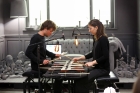
With Table Talk, the young American composer Alyssa Weinberg follows in Reich's footsteps, while enriching his legacy by experimenting with timbre. The two performers play four-handed on a “prepared” vibraphone: various everyday objects are placed on the instrument's bars to broaden its sound palette and introduce unexpected textures. These effects evoke the idea of a lively, informal conversation around a table—echoing the title of the work.
Philip Glass's Mad Rush, played here on marimba and vibraphone, was originally written for the organ of St. John the Divine Cathedral in New York, on the occasion of the Dalai Lama's first public address in North America. It was was conceived as welcome music so the length needed to be adapted to an uncertain arrival point. This dictated it's defining principles – repeatable sections and flexible duration. Instead of developing each of the themes, Glass reproduces them with slight variations, creating a hypnotic continuum where repetition invites meditation.
Het programma opent met het iconische Piano Phase van Steve Reich – hier uitgevoerd in een bewerking voor marimba's –, waarin twee instrumenten onvermoeibaar hetzelfde motief herhalen. Aanvankelijk perfect synchroon, raken ze geleidelijk aan uit de pas: terwijl het ene instrument het tempo aanhoudt, versnelt het andere geleidelijk, waardoor een progressieve verschuiving ontstaat. Zodra ze weer in unisono zijn, gaan ze verder met het volgende motief. In een subtiele mix van orde en chaos nodigt het proces de luisteraar uit om zich over te geven aan de onvoorspelbare patronen die uit de klank opduiken.
Met Table Talk sluit de jonge Amerikaanse componiste Alyssa Weinberg aan bij het erfgoed van Reich, maar verrijkt ze dat met een experimentele transformatie van het timbre. De twee uitvoerders spelen met vier handen op een vibrafoon waarop verschillende alledaagse voorwerpen uitgestald zijn die het klankpalet verbreden en onverwachte texture produceren. Het suggestieve effect doet denken aan een geanimeerd, intiem gesprek rond de tafel – een echo van de titel van het werk.
Mad Rush van Philip Glass, hier gespeeld op marimba en vibrafoon, is oorspronkelijk geschreven voor het orgel van de kathedraal St. John the Divine in New York, ter gelegenheid van de eerste openbare toespraak van de Dalai Lama in Noord-Amerika. Het stuk was bedoeld als welkomstmuziek, waarvan de duur moest kunnen worden aangepast aan een onzekere aankomsttijd – vandaar het principe van herhaalbare secties en de flexibele duur. In plaats van elk van de thema's uit te werken, reproduceert Glass ze met kleine variaties, waardoor een hypnotiserend continuüm ontstaat waarin de herhaling uitnodigt tot meditatie.
Steve Reich ouvre ce programme avec l’emblématique Piano Phase – présentée ici dans sa transcription pour marimbas –, où deux instruments répètent inlassablement le même motif. D’abord synchrones, ils s’éloignent progressivement l’un de l’autre pour créer un effet de déphasage : tandis que l’un maintient le tempo, l’autre accélère peu à peu, provoquant un décalage progressif. Dès qu’ils se sont rejoints à l’unisson, ils abordent le motif suivant. Dans un subtil mélange d’ordre et de chaos, le processus invite l’auditeur à s’abandonner aux espaces sonores qui se déploient.
Avec Table Talk, la jeune compositrice américaine Alyssa Weinberg s’inscrit dans l’héritage de Reich, mais l’enrichit d’un travail expérimental sur le timbre. Les deux interprètes jouent à quatre mains sur un vibraphone « préparé » : divers objets du quotidien sont placés sur les lames de l’instrument pour en élargir la palette sonore et introduire des textures inattendues. L’effet produit, incroyablement évocateur, suggère l’idée d’une conversation vivante et informelle autour d’une table – écho au titre de l’œuvre.
Mad Rush de Philip Glass, joué ici sur marimba et vibraphone, est écrit à l’origine pour l’orgue de la cathédrale St. John the Divine de New York, à l’occasion de la première prise de parole publique du Dalaï-Lama en Amérique du Nord. La pièce a été pensée comme une musique d’accueil, dont la durée devait pouvoir s’adapter à une heure d’arrivée incertaine – d’où son principe de sections répétables et sa durée flexible. Au lieu de développer chacun des thèmes, Glass les reproduit avec d’infimes variations, dessinant un continuum hypnotique où la répétition invite à la méditation.