Regie / Concept
Dansers
Magdelaine Hodebourg
Robson Ledesma
Elsa Tagawa
Mooni Van Tichel
Muziek
Ruben Orio, percussion
Eva Reiter, viola da gamba, Paetzold flute, voice
Ofer Smilansky, electronics
COLLABORATORS
Dramaturgie: Kristof Van Baarle
Kostuums: Mariona Puig & Jorgina Carrera (Maison 113)
Techniek: Vincent Malstaf, David Alonso, Maarten De Vrieze
Productieleiding: Britt Roger Sas
PRODUCTION
A Two Dogs Company, 2026,
In samenwerking met: Ictus Ensemble
Met de steun van:
Vlaamse gemeenschap,
Vlaamse Gemeenschapscommissie (VGC),
Tax Shelter stelsel van de Belgische Federale Overheid via Perpodium
PROTOCOL is a new collaboration between A Two Dogs Company / Kris Verdonck and Ictus. It is a dance performance for four dancers and three musicians performed in public spaces or large venues, danced and played among the audience.
Text by Kris Verdonck
PROTOCOL starts from the question:
What are the major political, technological, and sociological forces shaping our era and then who or what are the new gods of our time?
Dance & Live music
The performance seeks to be a ritual to conjure and confront these new gods, to give form to the chaos of our reality. The aim is to present the piece at festivals, in clubs, or other forms of collective celebration – a true ritual with the audience, pushing towards and perhaps even crossing a boundary together. To achieve this, the performance unfolds as one continuous crescendo lasting one hour, in which all media—dance, music, light, scenography—steadily build from nothing to a climax. The beat is the driving force behind this build-up. Live drumming is combined with electronic beats.
A ritualistic drumbeat inspired by Noh theatre flows into techno, which since the 1990s has been a more recent musical ritual of an ever-accelerating, dystopian world.
How far can the arc of tension be stretched? How large, how intense, how much pressure can be created and sustained?
In PROTOCOL, electronics (Ofer Smilansky), musicians (percussionist Ruben Martinez Orio and all-rounder Eva Reiter) and dancers (Mooni Van Tichel, Elsa Tagawa, Robson Ledesma and Magdelaine Hodebourg), play in the middle of the dance floor with anticipation and escalation. They move from minimal sounds, gestures, and silence to an overwhelming, intense climax that keeps growing.
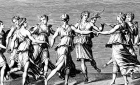
An in-between space opens up through this dynamic build-up and interaction between dancers and music. A space in which the new gods of our time may appear. This will not, however, be represented literally. The dancers wear costumes that magnify or abstract certain traits, and their interactions and movements are likewise transformed rather than literal.
It is not always the same gods who govern the heavens. It is not always the same rulers who collect taxes in the cities and in the countryside.
Italo Calvino
An inspiration for PROTOCOL is the ritual of the Hauka from the first half of the twentieth century in Ghana and Niger, as documented in Jean Rouch’s film Les Maîtres Fous. In these rituals, members of this community—mainly Ghanaians and Nigeriens for whom the urban context and the colonial structure of society were relatively new—invoked the new gods of technology, the city, and power. They appropriated the dynamics and positions that were overtaking their environment and began to perform them ritually.
They copied the generals, the commanders, the buildings, the locomotives, the weapons, the round table discussions of the British colonial occupier. The reasons for this remain debated, but the ritual nevertheless raises the question of who today’s new gods are and how we might relate to them. The Mad Politician, AI, Climate Change and the Ego are already strong contenders.
In an era when the status of facts and truth is shaky, the term “god” has again become an intriguing one. The designers of AI themselves do not fully understand how AI works, and for now it is largely about the marketing of expectations: AI, then, is a matter of belief. The same applies to populist, authoritarian leaders who refuse to be constrained by reality and demand absolute faith: whether Trump, Netanyahu, Putin, or Kim Jong Un.
Climate change is such a vast and sprawling crisis that its existence is not a matter of belief, but our relationship to it is; abstract, requiring conviction. Individualism, social media and neoliberalism have turned the Ego into something divine: we are our own gods and create our own image.
In The Disappearance of Rituals (2019), South Korean philosopher Byung-Chul Han traces festivals back to their ancient Greek, ritual origins. Festivals were then an exception to the regular course of everyday life, an interruption, a distinct intertime for contemplation and processing. In the search for the place of theatre, dance, and performance in our current crisis of meaning, the (music) festival/party/club is the ideal context, also to create a shared space with the audience, who are taken along on the trip of the performance. DJ and percussion work together to build tension and pressure through sound and to generate dynamics: aspects familiar from club nights or concerts, but here serving a different purpose.
PROTOCOL is de nieuwe samenwerking tussen A Two Dogs Company / Kris Verdonck en Ictus. Het is een dansvoorstelling voor vier dansers en 3 muzikanten in de publieke ruimte of in een grote ruimte, gedanst en gespeeld tussen het publiek.
Tekst van Kris Verdonck
PROTOCOL vertrekt vanuit de vraag:
Wie of wat zijn nieuwe goden van onze tijd? Wat zijn de grote politieke, technologische, sociologogische krachten van deze tijd?
De voorstelling wil een ritueel zijn om deze nieuwe goden te bezweren, om de chaos van onze werkelijkheid vorm te geven. De bedoeling is om deze voorstelling te presenteren op festivals, in clubs of andere vormen van collectief feest. Als een echt ritueel tussen het publiek, waarmee samen een grens opgezocht en misschien zelfs overschreden wordt.
Om dat te bereiken, zal de voorstelling bestaan uit één continu opbouwende spanningsboog van één uur lang, waarin alle media – dans, muziek, licht, scenografie – gestaag van nul naar een hoogtepunt toewerken. De beat is de drijvende kracht achter deze opbouw. Live drum wordt gecombineerd met electronische beats. De rol van drums in rituele vormen zoals Noh-theater loopt zo door van de beat van technomuziek, die sinds de jaren negentig een recentere vorm is van het muzikaal-ritueel vormgeven van een steeds versnellende, dystopische wereld.
Hoe lang kan de spanningsboog gerokken worden? Hoe groot, intens, hoeveel druk kan er gecreëerd en volgehouden worden?
In het midden van de dansvloer spelen electronica (Ofer Smilansky), muzikanten (drummer Ruben Martinez Orio en all-rounder Eva Reiter) en dansers (Mooni Van Tichel, Elsa Tagawa, Robson Ledesma en nog één te bevestigen naam) in PROTOCOL samen met anticipatie en opbouw. Van minimale klanken en gestes en stilte, gaat het naar een overweldigende, intense climax die maar blijft groeien.
Door deze dynamiek van opbouw en interactie tussen dansers en muziek, opent zich een tussenruimte waarin de nieuwe goden van onze tijd kunnen verschijnen. Dat zal evenwel niet letterlijk gebeuren of vormgegeven worden. De dansers dragen kostuums die bepaalde eigenschappen uitvergroten of abstraheren, hun interacties en bewegingen zijn niet letterlijk maar eveneens getransformeerd.
Het zijn niet altijd dezelfde goden die de hemel bestieren. Het zijn niet altijd dezelfde heersers die belastingen innen in de steden en op het platteland.
Italo Calvino
Een inspiratiebron voor PROTOCOL is het ritueel van de Hauka uit de eerste helft van de twintigste eeuw in Ghana en Niger, zoals in beeld gebracht in de documentaire Les Maîtres Fous van Jean Rouch. In deze rituelen riepen de leden van deze gemeenschap – voornamelijk Ghanezen en Nigerezen voor wie de stedelijke context en de koloniale structuur van de samenleving redelijk nieuw waren - de nieuwe goden van de techniek, de stad en de macht op.
Ze eigenden zich de dynamieken en posities die hun omgeving overnamen toe, en begonnen ze ritueel te performen. Ze kopieerden de generaals, de commandanten, de gebouwen, de locomotief, de wapens, het rondetafelgesprek, de protocollen van de macht … van de Britse koloniale bezetter. Over het waarom en de betekenis zijn verschillende opvattingen, maar dit ritueel opent wel de vraag naar wie de nieuwe goden vandaag de dag zijn en hoe we ons tegenover hen kunnen verhouden. De Waanzinnige Politicus, AI, het Ego en Klimaatverandering zijn alvast goede kanshebbers.
‘Goden’ is in tijden waarin het statuut van feiten en waarheid wankel is, opnieuw een interessante term. De ontwerpers van AI weten zelf niet precies hoe AI werkt, en vooralsnog gaat het vooral over marketing van verwachtingen: AI is dus een kwestie van geloof. Hetzelfde geldt voor populistische, autoritaire leiders die zich niet door de werkelijkheid laten hinderen en absoluut geloof eisen: of het nu Trump, Netanyahu, Putin, Bukele of Kim Jong-Un is.
De klimaatverandering is zo’n grote en wijdvertakte crisis, dat niet zozeer het bestaan ervan een kwestie van geloof is, maar wel onze verhouding ertoe; die abstract is en vanuit overtuiging dient te komen. Individualisme, social media en neoliberalisme hebben bovendien van het Ego iets goddelijks gemaakt: we zijn onze eigen god en creëren ons eigen beeld.
In Over het verdwijnen van rituelen (2019) traceert de Zuid-Koreaanse filosoof Byung-Chul Han festivals terug naar hun vroege Griekse, rituele oorsprong. Festivals waren toen een uitzondering op het regelmatige verloop van alledag, ze vormden een onderbreking, een aparte tussentijd voor contemplatie en verwerking. Op zoek naar de plaats van theater, dans en performance in onze huidige wereld in betekeniscrisis, is het (muziek)festival/feest/club de geknipte context, ook om een gedeelde ruimte te creëren met het publiek, dat meegenomen wordt in de trip van de voorstelling. De DJ en percussie werken samen om vanuit klank de spanning en druk op te bouwen en dynamiek te creëren: aspecten die we kennen uit club nights of concerten, maar die hier een andere inzet krijgen.
PROTOCOL est la nouvelle collaboration d'A Two Dogs Company / Kris Verdonck et d'Ictus. Il s'agit d'un spectacle de danse pour quatre danseur·euses et trois musicien·nes, qui se donne dans un espace public ou dans une grande salle, au milieu du public.
Texte de Kris Verdonck
La réflexion qui sous-tend PROTOCOL est la suivante:
Qui sont les nouvelles divinités de notre époque ? Quelles sont les grandes forces politiques, technologiques et sociologiques de notre temps ?
Le spectacle se veut un rituel qui vise à conjurer les nouvelles divinités et à refaçonner notre réalité chaotique. Le spectacle vise des festivals, les clubs ou tout autre dispositif de fête collective. À l'image d'un véritable rituel au sein du public. Avec lui, nous explorerons la limite à ne pas franchir. Pour l'atteindre, le spectacle déploiera une tension continue durant une heure, où tous les médias – danse, musique, lumière, scénographie – progressent graudellement de zéro vers le climax.
Le beat sera la force motrice de cette construction. La percussion live est combinée à des beats électroniques. La fonction de la percussion, à l'oeuvre dans les formes rituelles comme le théâtre Nô, trouve prolongement dans le rythme de la musique techno qui, depuis les années 90, constitue une forme plus récente de rituel musical, celui d'un monde dystopique en constante accélération.
Combien de temps la tension peut-elle être maintenue ? Quelle ampleur, intensité, pression peuvent être créées et maintenues ?
Dans PROTOCOL, musicien·nes et danseur·ses jouent avec les notions d’anticipation et progression sur la piste de danse. On passe du silence, d'un certain minimalisme, à un climax intense et bouleversant qui ne cesse de croître.
Ce ne sont pas toujours les mêmes dieux qui règnent au ciel, ce ne sont pas toujours les mêmes empires qui perçoivent les impôts dans les villes et les campagnes.
Italo Calvino
Le rituel Hauka de la première moitié du XXe siècle au Ghana et au Niger, tel que dépeint dans le documentaire Les Maîtres Fous de Jean Rouch, constitue l'ine des sources d'inspiration de PROTOCOL. À travers ces rituels, les membres de cette communauté – principalement des Ghanéen·nes et des Nigérien·nes pour qui le contexte urbain et la structure coloniale de la société étaient relativement nouveaux – invoquaient les nouvelles divini!tés de la technologie, de la ville et du pouvoir. Iels s'appropriaient les dynamiques et les positions qui envahissaient leur environnement et commençaient à les reproduire de manière rituelle. Iels imitaient les généraux, les commandants, les bâtiments, la locomotive, les armes, la table ronde, les protocoles du pouvoir... de l'occupant colonial britannique. Les opinions divergent quant à la raison et à la signification de ce rituel, mais celui-ci soulève la question de savoir qui sont les nouvelles divinités aujourd'hui et comment nous pouvons nous positionner à leur égard. Les politicien·nes fous·folles, l'IA, l'ego et le changement climatique formenr déjà d'excellents candidats.
À une époque où le statut des faits et de la vérité est fragile, le terme « dieux·déesses » retrouve de son intérêt. Les concepteur·ices de l'IA ne savent pas exactement eux·elles-mêmes comment elle fonctionne, et pour l'instant, il s'agit surtout de commercialiser des attentes : l'IA est donc une question de croyance. Il en va de même pour les dirigeant·es populistes et autoritaires qui font fi du réel et exigent une croyance absolue, qu'il s'agisse de Trump, Netanyahu, Poutine, Bukele ou Kim Jong-Un.
Le changement climatique est une crise si vaste et si ramifiée que ce n'est pas tant son existence qui est une question de croyance, mais plutôt notre rapport à celui-ci, qui est abstrait et doit émaner d'une conviction. L'individualisme, les réseaux sociaux et le néolibéralisme ont par ailleurs transformé l'ego en une entité divine : nous sommes notre propre dieu·déesse et créons notre propre image.
Dans "Over het verdwijnen van rituelen" (2019), le philosophe sud-coréen Byung-Chul Han retrace l'origine des festivals jusqu'à leurs débuts rituels dans la Grèce ancienne. À l'époque, les festivals constituaient une exception dans le cours régulier de la vie quotidienne, ils formaient une interruption, un intermède distinct pour la contemplation et l'assimilation. Le festival (de musique)/la fête/le club est le contexte idéal pour l’exploration de la place du théâtre, de la danse et de la performance dans notre monde actuel en crise de sens, et ce notamment pour créer un espace partagé avec le public, qui est emporté dans le trip du spectacle. Le DJ et les percussions travaillent en synergie pour créer, à partir du son, une tension et une pression et générer une dynamique : des aspects qui nous sont familiers des soirées en club ou des concerts, mais qui acquièrent ici une autre dimension.
Agenda for this project
- Date Show Location
-
Sat 05.09 Protocol (Kris Verdonck) Meakusma Festival - Eupen - Belgium